Between ages 2 and 6, children go through an extraordinary period of inner development. They observe, imitate, handle objects, repeat and learn without even realising it. Yet many parents still think Montessori activities at home require expensive equipment or special training. The reality is simpler and more reassuring. Through everyday actions, a prepared environment and an appropriate adult approach, you can support your child's independence, fine motor skills and concentration while respecting the principles of Montessori education.
In this article, I share a selection of simple Montessori activities, inspired by our Tuesday and Thursday Akamai Kids workshops, that you can easily recreate at home.

Between ages 2 and 6, children go through what Maria Montessori called sensitive periods :
At this age, children have a deep need to do things themselves. Offering suitable activities meets this natural need without forcing or accelerating learning.
Offering Montessori activities at home does not mean ‘bringing school home’.
It means giving children a safe setting consistent with their group experiences and strengthening an education that respects the pace of early childhood.

In Montessori education, adults begin by observing.
What currently interests your child? What do they naturally gravitate towards? Movement, water, objects to transfer, language?
This observation helps you offer an activity at the right time, without pressure.
You do not need lots of equipment.
A few carefully chosen activities stored at the child's height are enough. External order helps children structure their inner world.
Adults demonstrate slowly, then step back.
Mistakes are part of learning. In Montessori, we support without constantly correcting.
Goals: coordination, concentration, self-confidence
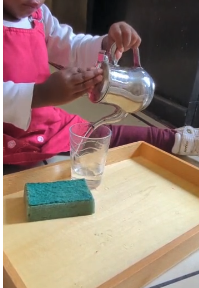
Materials: two jugs, a tray, a cloth
The child pours water from one container into another.
This key Montessori practical-life activity is common in our workshops because it naturally captures children's attention.
👉 At home, start with a little water and accept small spills.
Goals: independence, fine motor skills, self-esteem
Materials: easy-to-put-on clothes, a dressing frame if available
Letting children fasten buttons and zips and put on their shoes develops patience and perseverance.
Even if it takes longer, it is a valuable educational investment.

Goals: precise movements, hand–eye coordination
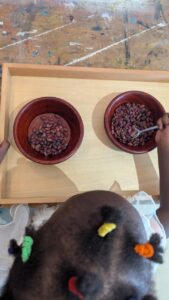
Materials: two bowls, a spoon, seeds or rice
Especially popular between ages 2 and 4, this activity helps children refine their movements and focus on one task at a time.
Goals: strengthening fingers, indirect preparation for writing
Materials: clothes pegs, small objects, boxes
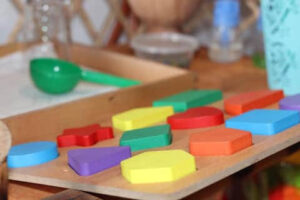
Sorting by colour, size or shape stimulates logic while preparing the movements needed for writing.
Goals: problem-solving, sustained attention
Materials: a simple, age-appropriate puzzle
In our Akamai Kids workshops, we often observe children concentrating for long periods when facing a challenge suited to their level.
Offering one activity at a time lets children become fully immersed without overload.
👉 Fewer, better-chosen activities encourage deep concentration.
In Montessori, parents are neither passive spectators nor directors.
They are present, calm and observant. They demonstrate once, then let the child explore.
Saying:
builds confidence and enjoyment of learning far more than a simple ‘well done’.
In our Tuesday and Thursday Montessori workshops, children benefit from:
Parents often tell us their children become calmer, more confident and more engaged in everyday activities.
Activities at home then become even more meaningful, extending what children already experience in workshops.
Offering Montessori activities at home between ages 2 and 6 gives children simple opportunities to do things themselves, learn at their own pace and grow with confidence.
With a little equipment, plenty of observation and a caring attitude, every parent can truly support their child's development.
If you would like to go further, our Akamai Kids workshops are designed as a space of exploration, respect and joy for children—and parents too.







Laura
23 December 2025Let's admit it is hard to find these moments in our circumstances, especially when we are rushing to provide for their needs. But I will try. I can certainly give my child 10 minutes!
Admin
23 December 2025I understand. We just need to remember that our children are our best investment right now.